200+ Spanish Puns That Are Funny, Clever & Muy Good!
Spanish puns are funny because they can turn an ordinary word into an unexpected punchline. The best examples use wordplay, double meanings, homonyms, vocabulary, and cultural expressions to create a tiny surprise. A good joke can make a Spanish learner laugh while quietly teaching a useful phrase.
Try these playful examples: Why did the tomato blush? Because it saw the salsa. What does a Spanish-speaking bear have? Gummy oso. Why was the math book sad? Too many problems. These work best when the English setup meets a familiar Spanish word such as salsa, oso, or problemas.
The real charm comes from recognizing the second meaning. SpanishDictionary demonstrates this beautifully with jokes involving nada, salsa, techo, and la tina. The humor isn’t merely translation; it depends on hearing or understanding how the Spanish words connect.
A few more to keep the laughter going:
- What do you call a Spanish fish with no eyes? Pez sin ojos.
- Why did the bicycle get tired? It was dos-tired.
- What does a lazy kangaroo do? Take a canguro break.
- What did the baker need? Más pan!
- Why did the skeleton need a friend? It had no huesos to bring.
- What does a Spanish dog magician say? Labracadabrador!
These are especially useful for casual conversations because they are short, recognizable, and easy to explain. If someone doesn’t immediately understand one, don’t worry—that explanation is often half the fun. A quick translation or pronunciation note can turn a groan-worthy pun into a memorable vocabulary lesson.
Romantic Spanish Puns
Romantic Spanish puns add a playful twist to compliments, crush conversations, dating texts, and Valentine’s Day messages. Instead of relying only on traditional romance, they combine amor, corazón, ojos, cariño, romantic jokes, and bilingual wordplay to make a message feel lighter and more personal.
For example: “Do you have a map? Because I’m lost in your ojos.” Another playful line is “You must have my corazón, because it keeps choosing you.” They aren’t meant to sound like serious poetry; their charm comes from being deliberately cheesy.
Here are some easy romantic Spanish puns:
- Are you salsa? Because you add spice to my vida.
- You must be queso, because you melt my corazón.
- I think we have buena química—and excellent tacos.
- You are muy special to me.
- I’m falling for you—¡qué caída tan bonita!
- Are you mi cielo? Because you brighten my day.
- You had me at hola.
- Our chemistry is stronger than café con leche.
The best romantic line depends on the relationship. With a close partner, a ridiculous taco joke can be adorable; with a new crush, something short like “You had me at hola” feels much safer. The secret is matching the humor to the moment rather than forcing a pun into every conversation.
Funny Spanish Puns Captions
Funny Spanish puns make excellent captions because they are short, visual, and instantly recognizable. Travel photos, restaurant pictures, beach days, fiestas, and food posts all provide natural opportunities for Spanish captions, bilingual humor, taco wordplay, fiesta phrases, and playful expressions.
Try captions such as “Taco ’bout a good day,” “Hola sunshine,” “Keep calm and siesta on,” or “Life’s better with a little salsa.” They work because the Spanish word supplies cultural flavor while the English sentence keeps the joke understandable to a broad U.S. audience.
More caption-ready ideas:
- Hola from my happy place.
- Estoy muy bien hoy.
- Fiesta mode: activated.
- Living la vida pun.
- Nacho average weekend.
- Salsa and smiles.
- Keep calm and say olé.
- Tortilla-ly having fun.
- Siesta now, worry later.
- Just here for the churros.
- A little loco, a lot of happiness.
- Guac-ing my way through the day.
For a travel photo, use a place-related caption. For food, choose a taco, salsa, queso, or churro joke. For a selfie, short lines such as “Muy cool” or “Hola, sunshine” usually look cleaner than a long joke.
Funny Spanish Puns One Liners
Spanish puns one-liners work because there is almost no setup. You see the sentence, catch the wordplay, and move on with a smile. Common ingredients include hola, olé, taco, queso, salsa, siesta, fiesta, and Spanglish, making them particularly accessible to English-speaking audiences.
Some favorites include “I’m nacho average Spanish fan,” “Let’s taco ’bout Spanish culture,” and “Fiesta first, worries later.” The humor is intentionally simple. These aren’t linguistic lectures; they’re quick little jokes designed for texts, comments, captions, or group chats.
Here are more:
- Hola, I barely know her.
- Olé all day.
- Keep it cool.
- Salsa is my love language.
- Nacho problem.
- Queso please.
- Feeling loco today.
- Taco ’bout funny.
- Living that siesta life.
- Say hola to good times.
- Spanish vibes activated.
- Keep calm and eat churros.
- Life is better with guac.
- No drama, just salsa.
One-liners are also easy to personalize. Add someone’s name, a location, or the situation you’re actually in, and the joke becomes more memorable than a generic copy-and-paste caption.
Clever Spanish Puns for Instagram
Instagram rewards concise, recognizable humor, which explains why Spanish puns fit naturally into captions and comments. Instagram captions, travel photos, food photography, bilingual humor, and lifestyle posts can all benefit from a small Spanish twist without requiring the audience to speak fluent Spanish.
Consider “Sun’s out, sol out,” “Empanada my heart,” “Nacho average selfie,” or “Don’t be jalapeño my business.” These work because English-speaking readers can understand the sentence while the Spanish word adds an unexpected layer.
More Instagram-friendly options:
- Taco ’bout a great day.
- Churro vibes only.
- Feeling muy bien.
- Salsa dancing through life.
- Keep your guac together.
- Fiesta mode activated.
- Tortilla-ly in love.
- Viva good times.
- Spanish vibes only.
- Hola from paradise.
- Life’s short—eat the burrito.
- Keep calm and salsa on.
For better engagement, match the pun with the picture. A beach shot can use sol or hola sunshine; a Mexican-food dinner can use taco, queso, or guac; and a Spain travel photo can use olé, fiesta, or siesta.
Spanish Puns in English
Spanish puns in English are especially effective for U.S. readers because the punchline doesn’t require full Spanish fluency. The English sentence provides context while a Spanish word—hola, corazón, siesta, fiesta, salsa, queso, taco, or olé—creates the comedic turn.
That bilingual structure is also useful for learners. A person may already recognize hola or taco, then gradually become familiar with words such as corazón, viaje, sol, and comida. Humor gives the vocabulary a memorable emotional hook.
Try these:
- I tried learning Spanish, but I’ll taco ’bout it later.
- Spanish food speaks straight from the corazón.
- Living la vida siesta.
- When in doubt, add salsa.
- Hola is always a good start.
- Life sounds better with a little olé.
- My Spanish vocabulary is growing my fast.
- I came for the language and stayed for the churros.
- This vacation is going muy bien.
- Spanish flavor makes everything more divertido.
This approach is strongest when the Spanish word is recognizable or easily explained. If the audience has no idea what the word means, the joke can lose its rhythm, so beginner-friendly bilingual puns are usually the safest choice.
Spanish Puns One Liners
Short Spanish puns are perfect when you need humor that fits inside a text, comment, greeting card, or social post. The recurring vocabulary olé, hola, muy, salsa, fiesta, taco, siesta, and queso makes these jokes easy to scan and easy to share.
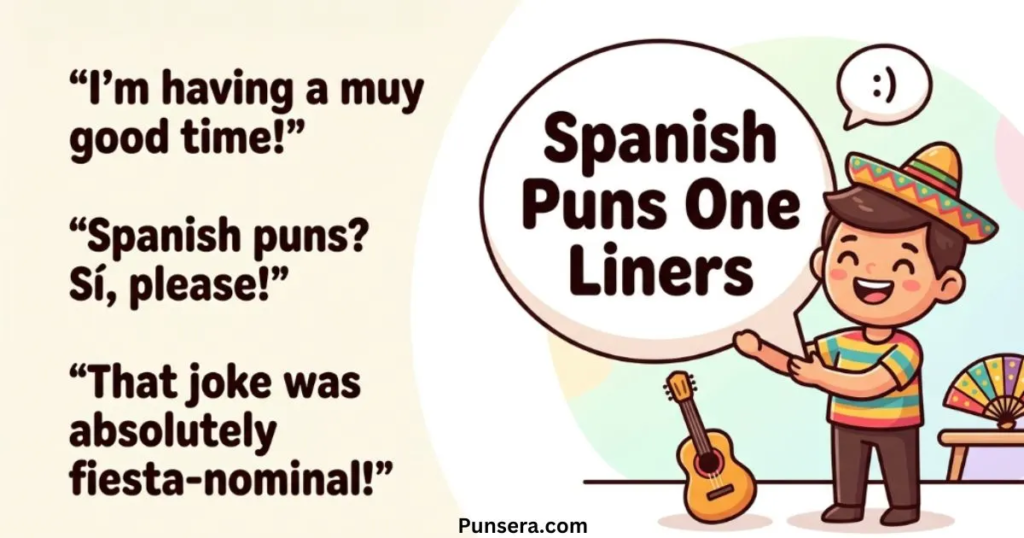
Here are some quick options:
- Olé vibes only.
- Taco time!
- Muy cool.
- Hola mood.
- Fiesta life.
- Si, please.
- Nacho is bad.
- Salsa days.
- Viva fun.
- Ole energy.
- Queso champion.
- Churro happy.
- Guac and roll.
- Keep it loco.
- Burrito goals.
The beauty of this format is flexibility. You can use one as a caption, pair it with an emoji, turn it into a greeting, or add it to a meme. The shorter the joke, the more important the word choice becomes, so choose something that reads naturally rather than forcing a complicated pun.
Spanish Puns Captions
Spanish puns captions are ideal when you want your photo to communicate personality without becoming a paragraph. The most effective examples combine Spanish expressions, bilingual captions, food humor, travel vocabulary, fiesta energy, and simple wordplay into a line that can be understood at a glance.
For a sunny travel post:
- Hola sunshine.
- Find your soul.
- Viva the moment.
- Tortilla-ly wandering.
- Feeling muy viajero.
For food photos:
- Nacho average meal.
- Queso please.
- Life is short; eat churros.
- Guac-ing all out.
- Taco ’bout delicious.
For parties:
- Fiesta mode on.
- Salsa and smiles.
- Olé all night.
- Keep it caliente.
- Siesta tomorrow, fiesta tonight.
A strong caption doesn’t need to explain the joke. If the visual supplies the context, the words only need to add the punch. That’s why a simple “Taco ’bout a good day” can outperform a complicated joke beneath the right food or vacation photo.
Conclusion
Spanish puns are a fun way to mix Spanish humor, bilingual wordplay, clever jokes, funny captions, and cultural expressions into something memorable. Whether you need a quick one-liner, a romantic joke, an Instagram caption, or a playful language-learning moment, the right pun can turn an ordinary conversation into a laugh.
From tacos and salsa to fiestas, siestas, queso, and “hola,” Spanish puns prove that language learning doesn’t have to feel like studying. Pick your favorite, share it with a friend, and don’t be afraid to get a little loco with your wordplay. ¡Olé!
FAQ Section
What are some easy Spanish puns to learn?
Start with familiar words such as hola, taco, salsa, queso, fiesta, siesta, and olé. Simple bilingual jokes are easiest because you can understand the English setup while learning how the Spanish word creates the punchline.
How can I use Spanish puns in conversation?
Use them casually with friends, classmates, language partners, or Spanish-speaking coworkers when the situation is appropriate. Short jokes are easiest to remember, especially when they use familiar vocabulary.
Are Spanish puns suitable for all ages?
Most wordplay-based Spanish puns are family-friendly. Food jokes, animal jokes, simple bilingual lines, and clean one-liners are generally appropriate for kids, teens, adults, and language learners.
What makes Spanish puns unique?
Spanish offers many opportunities for wordplay through homonyms, sound similarities, double meanings, idioms, and culturally specific expressions. Some jokes work because a Spanish word has two meanings, while others depend on pronunciation.
Can Spanish puns improve my Spanish?
Yes. Puns can reinforce vocabulary, pronunciation, idioms, and contextual meaning. SpanishDictionary specifically uses jokes as a playful way to practice Spanish, while other language-learning resources describe humor as a useful way to engage with cultural expressions.
What makes a good Spanish pun?
A good Spanish pun usually combines a recognizable word or phrase with a surprising second meaning, sound similarity, cultural reference, or bilingual twist. The strongest jokes are easy to understand but still unexpected.
Can I use Spanish puns on social media?
Absolutely. Short bilingual puns are particularly suitable for Instagram captions, TikTok posts, WhatsApp statuses, comments, and travel photos. Match the pun to the image so the visual and joke reinforce each other.
How can I create my own Spanish puns?
Start with a common Spanish word, find a second meaning or similar-sounding English phrase, and build a short setup around it. Words such as hola, taco, queso, salsa, sol, and fiesta provide easy starting points.