150+ Good Puns That Are Funny Clever and Simply Brilliant
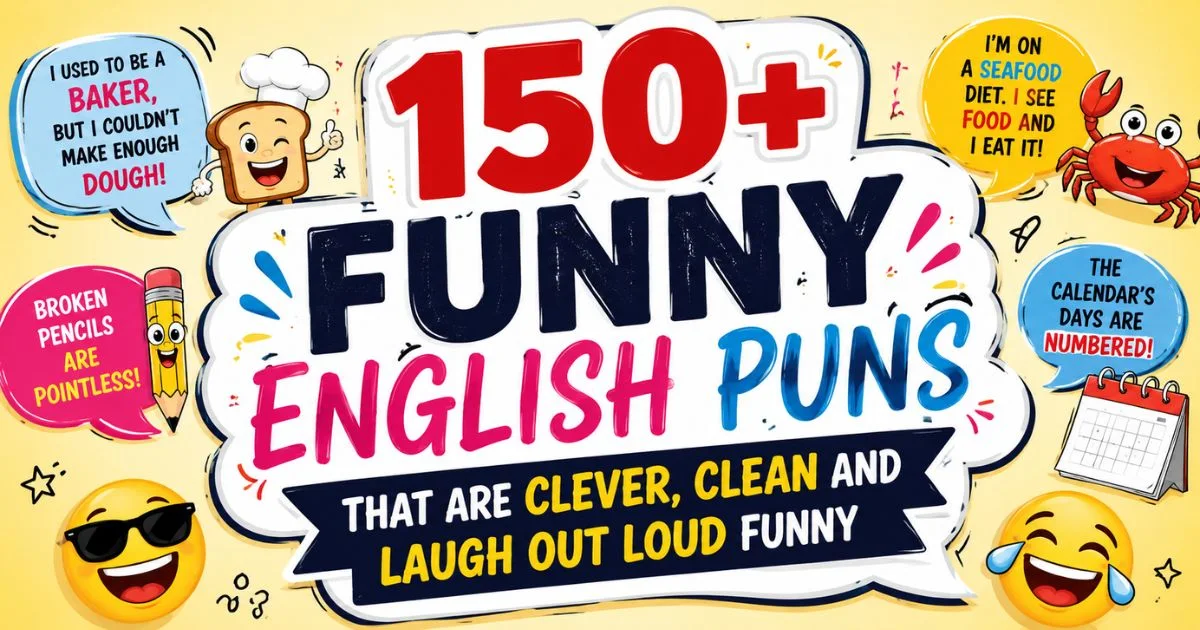
Nothing makes a conversation more entertaining than a clever pun. Whether you’re looking for a witty Instagram caption, a classroom-friendly joke, or a hilarious one-liner to make friends laugh, funny English puns are a timeless form of humor. They play with words, double meanings, and similar sounds to create jokes that are both clever and memorable.
In this collection, you’ll discover over 150 of the best puns, learn how English wordplay works, explore different types of puns, and even pick up tips for creating your own. Whether you’re a student, teacher, writer, or simply someone who enjoys a good laugh, these puns are sure to brighten your day.
What Are English Puns and Why Are They So Funny?
An English pun is a joke that uses a word with more than one meaning or words that sound alike to create humor. This form of wordplay surprises the reader by leading them to expect one meaning before revealing another.
Why People Love Puns
People enjoy puns because they:
- Make conversations more entertaining.
- Show creativity and quick thinking.
- Help improve language skills.
- Are suitable for almost every age group.
- Turn ordinary words into unexpected jokes.
Quick Examples
| Pun | Why It’s Funny |
| I’m reading a book about anti-gravity. It’s impossible to put down. | “Put down” has both a literal and figurative meaning. |
| Time flies like an arrow. Fruit flies like a banana. | The sentence changes meaning halfway through. |
| I used to be a baker, but I couldn’t make enough dough. | “Dough” means bread mixture and money. |
| I wondered why the baseball was getting bigger. Then it hit me. | “Hit me” works literally and figuratively. |
| The scarecrow won an award because he was outstanding in his field. | “Outstanding” refers to both excellence and standing outside. |
What Makes a Good Pun?
A memorable pun usually includes:
- A double meaning
- Similar-sounding words
- A surprising twist
- A simple, easy-to-understand setup
- A short punchline
Best Funny English Puns to Make Everyone Laugh
Here are some of the funniest English puns that work in everyday conversations.
- I told my computer I needed a break. It said, “No problem, I’ll go to sleep.”
- I only know 25 letters of the alphabet. I don’t know Y.
- I used to play piano by ear, but now I use my hands.
- The math teacher has too many problems.
- I stayed up all night wondering where the sun went. Then it dawned on me.
- Broken pencils are pointless.
- The bicycle couldn’t stand on its own because it was two-tired.
- I was struggling to figure out how lightning works. Then it struck me.
- I don’t trust stairs because they’re always up to something.
- I got a job at a bakery because I kneaded the dough.
- The calendar’s days are numbered.
- I used to be a banker, but I lost interest.
- The coffee filed a police report because it got mugged.
- The fisherman was hooked on his job.
- The dentist had a filling day at work.
- The shoe factory closed because it couldn’t find its sole.
- The chef quit because he couldn’t handle the heat.
- The lamp wasn’t very bright, but it had a glowing personality.
- The gardener planted jokes and grew laughter.
- The musician hit the right note every time.
- The tailor always suited his customers.
- The baker rose to every challenge.
- The painter brushed off criticism.
- The astronaut needed space.
- The photographer developed a positive outlook.
- The librarian had the last word.
- The golfer had plenty of drive.
- The electrician was shocked by the news.
- The actor always played his part.
- The chef’s jokes were well-seasoned.
- The snowman had a meltdown.
- The clock worked around the clock.
- The cookie felt crummy after the workout.
- The tomato couldn’t ketchup with the others.
- The bee had a buzzing social life.
Why These Puns Work
Most of these jokes rely on:
- Double meanings
- Homophones
- Everyday situations
- Short punchlines
- Familiar vocabulary
That combination makes them easy to understand and enjoyable to share.
Clever English Puns That Show Off Smart Wordplay
Some puns require a little more thought, making them especially satisfying when the punchline clicks.
Clever Pun Examples
- A boiled egg every morning is hard to beat.
- I wondered why the frisbee kept getting bigger. Then it hit me.
- The butcher backed into the meat grinder and got a little behind in his work.
- Never trust atoms. They make up everything.
- I’m friends with all electricians because they know how to conduct themselves.
- The librarian’s favorite exercise is checking out books.
- A roof once told a chimney, “You’re exhausting.”
- The magician quit his job because he disappeared from the competition.
- The ocean waved because it recognized the shore.
- The gardener was rooting for everyone.
What Makes These Puns Clever?
Clever puns often:
- Use double meanings instead of obvious jokes.
- Reward careful reading.
- Encourage creative thinking.
- Combine logic with humor.
- Stay concise while delivering an unexpected twist.
Because they challenge the brain before delivering the joke, they’re popular with writers, teachers, comedians, and anyone who enjoys playful language.
Clean English Puns for Kids, Students and Families
Looking for clean English puns that everyone can enjoy? These family-friendly jokes are perfect for classrooms, dinner tables, school events, and social gatherings. They rely on clever wordplay instead of inappropriate humor, making them suitable for readers of all ages.
Family-Friendly English Puns
- Why was the math book sad? It had too many problems.
- The pencil wanted to be famous because it had a good point.
- The cookie visited the doctor because it felt crummy.
- The music teacher always stayed in tune with the class.
- The moon skipped dinner because it was already full.
- The computer caught a cold because it left its Windows open.
- The rabbit became a comedian because it had great hare-raising jokes.
- The sunflower smiled because it loved bright days.
- The turtle finally won the race—it took things one step at a time.
- The owl earned top grades because it was wise.
Why Kids Love Puns
- They make learning vocabulary fun.
- They encourage creative thinking.
- They improve reading comprehension.
- They introduce figurative language in an engaging way.
- They help children remember new words through humor.
Tip: Teachers often use puns as classroom icebreakers, writing prompts, or vocabulary activities because they make lessons more memorable.
Funny English Puns by Category

Different situations call for different kinds of puns like birthday puns. Here are some of the best examples grouped by popular topics.
Food Puns
- Lettuce celebrate!
- You’re one in a melon.
- Olive you so much.
- Donut worry, be happy.
- You’re the apple of my pie.
- Orange you glad we’re friends?
- Life is gouda with you.
- Taco ’bout awesome!
- I loaf spending time with you.
- You’re bacon me smile.
Animal Puns
- Whale, hello there!
- Owl always love you.
- Bear with me.
- Alpaca my bags.
- You’re pawsome.
- Don’t be koi.
- That’s un-frog-ettable.
- Seal you later.
- I’m otterly amazed.
- Bee yourself.
Love Puns
- You have a pizza my heart.
- We’re mint to be.
- Owl be yours forever.
- I love you berry much.
- You make miso happy.
- We’re a perfect pear.
- You stole my heart, lock, stock, and barrel.
- Aloe you vera much.
- I’m nuts about you.
- Every day with you is egg-cellent.
Work & Office Puns
- Let’s tackle this one spreadsheet at a time.
- You’re the highlight of my workday.
- This meeting is paper-thin.
- I excel at Excel.
- Let’s stay on the same page.
- Deadline? I prefer finish line.
- Teamwork is our secret formula.
- File this under “Success.”
- We’re printing progress.
- Coffee first, emails second.
Travel Puns
- Rome wasn’t explored in a day.
- Let’s take life one trip at a time.
- Sea you soon.
- Vacation mode is plane awesome.
- I’m passport-ionate about travel.
- Let’s make every mile count.
- Adventure is calling.
- Take the scenic route.
- Life’s a journey—enjoy the ride.
- Keep calm and carry-on.
Technology Puns
- You’ve got great cache.
- Our friendship has excellent bandwidth.
- Don’t byte off more than you can chew.
- Stay connected.
- You’re pixel-perfect.
- That’s a hard drive to forget.
- No bugs, just features.
- I’m a fan of your interface.
- Let’s reboot and try again.
- You’re coding my heart.
Book Puns
- Let’s turn the page.
- You’re writing your own story.
- That plot twist was novel.
- Book it!
- Reading between the lines.
- Shelf control is difficult.
- Every chapter counts.
- A well-read joke never gets old.
- Don’t judge me by my cover.
- That’s a bestseller of a joke.
Music Puns
- Don’t fret, be happy.
- Note-worthy performance!
- That’s music to my ears.
- Stay in tune.
- Let’s face the music.
- You’re pitch perfect.
- Keep the beat alive.
- Harmony makes everything better.
- Rock on!
- Life has its ups and downbeats.
Different Types of English Puns Explained
Not all puns work the same way. Understanding the different types of English wordplay can help you appreciate—and create—better jokes.
| Type of Pun | Description | Example |
| Homophonic Puns | Use words that sound alike but have different meanings. | “I scream” and “ice cream.” |
| Homographic Puns | Use words that are spelled the same but have different meanings. | “The duck said, ‘Bill me later.'” |
| Compound Puns | Combine multiple puns in one sentence. | “The bicycle was two-tired and couldn’t handle the pressure.” |
| Recursive Puns | Require understanding another pun first. | A layered joke that reveals a second meaning after the first. |
| Visual Puns | Use pictures or symbols instead of only words. | A drawing of a fish carrying schoolbooks labeled “School Fish.” |
| Tom Swifties | A sentence where the adverb creates the joke. | “I’m exhausted,” Tom said tiredly. |
| Spoonerisms | Swap the first sounds of words to create humorous phrases. | “A blushing crow” instead of “crushing blow.” |
Which Type Is Most Popular?
For everyday conversations, homophonic puns are the most common because they’re easy to understand and work well in spoken English. Writers and comedians often mix several types to make jokes more creative and memorable.
How to Create Your Own English Puns
The best English puns often come from everyday words. You don’t have to be a comedian to create clever wordplay—you simply need to spot words with multiple meanings or similar sounds.
1. Look for Double Meanings
Many English words have more than one meaning. Using those meanings creatively is the foundation of a good pun.
Example:
- I used to be a banker, but I lost interest.
Here, “interest” refers to both financial earnings and personal enthusiasm.
2. Use Homophones
Homophones are words that sound alike but have different meanings and spellings.
Examples include:
- Flour / Flower
- Sea / See
- Sole / Soul
- Knight / Night
- Pair / Pear
These words naturally create opportunities for funny jokes.
3. Connect Related Words
Think of words connected to a topic.
For example, if your topic is coffee:
- Bean
- Brew
- Roast
- Mug
- Espresso
- Latte
- Caffeine
You can combine these into creative puns like:
Espresso yourself.
4. Keep It Short
The funniest puns are usually one sentence long. A simple setup followed by a surprising punchline is easier to remember and share.
5. Read More Puns
Reading books, comics, greeting cards, and joke collections expands your understanding of different types of puns and inspires fresh ideas.
Common Mistakes to Avoid
- Explaining the joke.
- Making the setup too long.
- Using confusing words.
- Forcing a pun where it doesn’t fit.
- Repeating overused jokes without adding a fresh twist.
Pro Tip: Great puns feel natural. If readers have to work too hard to understand the joke, it’s time to simplify it.
When and Where to Use English Puns

One reason puns remain popular is their versatility. A well-timed joke can make conversations, presentations, and even marketing campaigns more engaging.
| Situation | How Puns Help |
| Social Media | Create memorable captions and increase engagement. |
| Greeting Cards | Add humor to birthdays, holidays, and celebrations. |
| Classroom | Make lessons more interactive and enjoyable. |
| Public Speaking | Break the ice and keep audiences interested. |
| Workplace | Lighten meetings and strengthen team relationships. |
| Marketing | Build memorable slogans and advertising campaigns. |
| Brand Names | Make businesses more recognizable and shareable. |
| Icebreakers | Start conversations with humor. |
Popular Uses
- Instagram captions
- Facebook posts
- X (Twitter) updates
- Birthday cards
- Wedding speeches
- Classroom activities
- Team-building events
- Business presentations
- Advertising campaigns
- Everyday conversations
The key is knowing your audience. A clean, clever pun works almost anywhere, while more complex wordplay may be better suited to readers who enjoy language-based humor.
Why English Puns Improve Communication and Creativity
Puns aren’t just entertaining—they also help develop valuable language skills.
Build a Stronger Vocabulary
Because puns rely on multiple meanings, they encourage readers to learn new words and understand how they’re used in different contexts.
Improve Language Learning
English learners often discover that puns make lessons more memorable. Recognizing double meanings helps improve reading and listening skills.
Encourage Creative Thinking
Creating a pun requires making unexpected connections between words. This strengthens problem-solving and flexible thinking.
Make Public Speaking More Engaging
A clever pun at the beginning of a presentation can capture attention and make speakers seem more approachable.
Improve Writing Skills
Writers use puns to:
- Add personality.
- Create memorable headlines.
- Write engaging dialogue.
- Develop humorous stories.
- Make content more shareable.
Strengthen Memory
Humor helps people remember information. That’s why teachers, marketers, and public speakers often use puns to make important ideas stick.
Conclusion
English puns prove that language can be both clever and entertaining. Whether you’re looking for a quick laugh, writing a funny caption, teaching students, or sharpening your communication skills, funny English puns offer something for everyone.
From simple one-liners to smart wordplay and creative double meanings, puns encourage us to see language from a fresh perspective. They’re easy to share, suitable for all ages, and useful in everything from everyday conversations to professional presentations.
Now that you’ve explored different styles, categories, and techniques, try creating a few puns of your own. You might be surprised at how much fun playing with words can be—and who knows, your next pun could be the one everyone remembers.
FAQs
What is an English pun?
An English pun is a joke that uses wordplay, similar-sounding words, or multiple meanings to create humor.
What is the difference between a pun and a joke?
A joke can use any type of humor, while a pun specifically relies on clever language and double meanings.
Why do people enjoy puns?
Puns surprise the brain with an unexpected meaning, making them satisfying, memorable, and fun to share.
Are puns suitable for kids?
Yes. Many puns are clean, educational, and perfect for children, classrooms, and family activities.
How do I write a good pun?
Start with words that have multiple meanings or similar sounds, keep the joke short, and end with a surprising punchline.
What are the main types of puns?
The most common types include homophonic, homographic, compound, recursive, visual, Tom Swifties, and spoonerisms.
Can puns help with learning English?
Absolutely. Puns improve vocabulary, reading comprehension, pronunciation, and understanding of figurative language.
Where can I use English puns?
You can use them in conversations, social media captions, greeting cards, speeches, classrooms, presentations, and marketing campaigns.