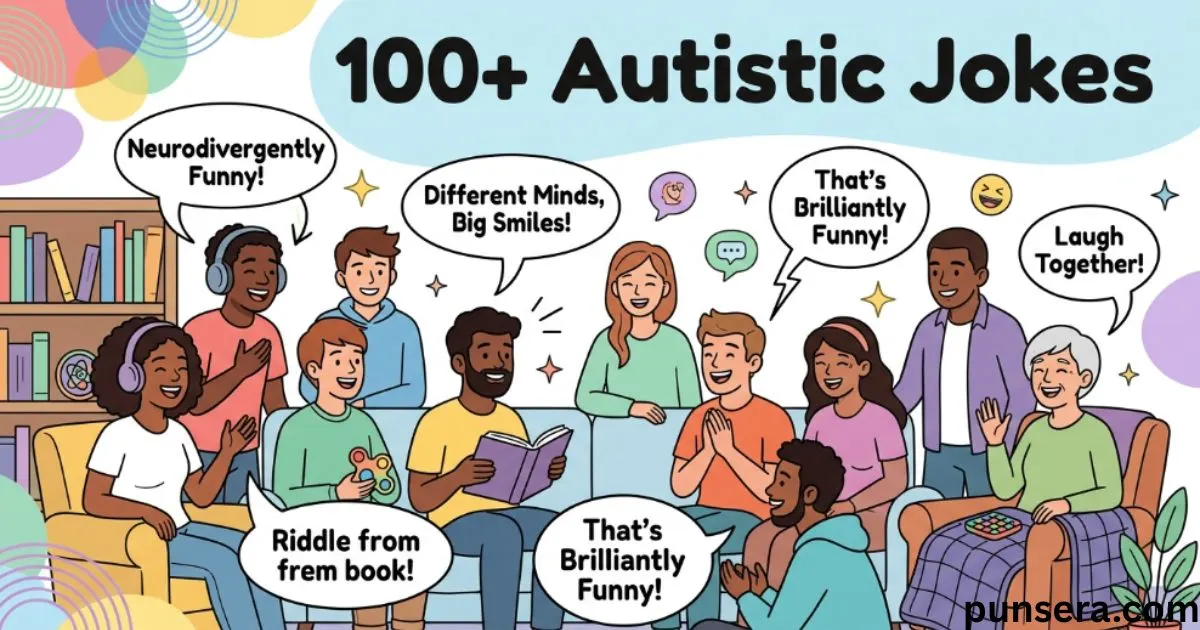
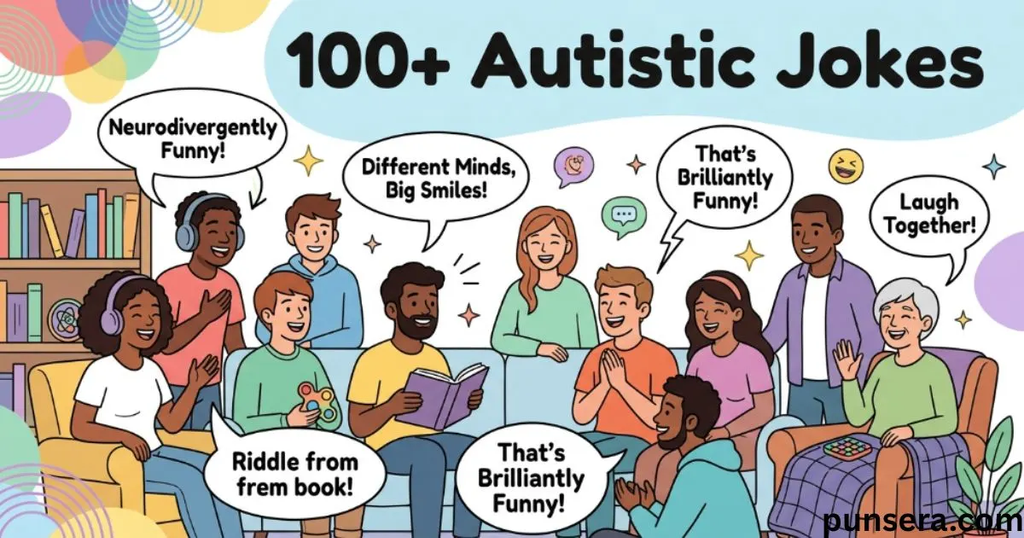
100+ Autistic Jokes That Are Clever, Clean & Funny
Autistic jokes can be genuinely funny when they focus on wordplay, routines, sensory moments, special interests, communication, and everyday life instead of stereotypes. If you are searching for clean autism humor, neurodivergent jokes, spectrum humor, relatable one-liners, and clever puns, this collection keeps the punchlines playful and human.
From an editorial perspective, the funniest humor often comes from recognizable moments: preparing for a conversation, protecting your quiet time, getting deeply interested in one topic, or needing a plan for the plan. These autistic jokes, literal humor, pattern jokes, social humor, sensory jokes, and family-friendly lines are designed to create a laugh people can share rather than a joke made at someone else’s expense.
Funniest Autistic Short Jokes
The best short autistic jokes usually need only a few words to create the setup and punchline. These clean jokes, autism humor, short puns, relatable moments, and clever wordplay turn ordinary experiences into quick laughs without reducing anyone to a stereotype.
Good humor can also come from the little details of daily life: routines, headphones, snacks, calendars, special interests, quiet rooms, and unexpected changes. These everyday jokes, sensory humor, literal comedy, neurodivergent humor, and lighthearted punchlines are easy to share with friends or family.
- My social battery has a charger, but apparently it only works overnight.
- I made a plan for Saturday, then made a backup plan in case Saturday had opinions.
- Small talk asked me to introduce myself, so I prepared a 14-slide presentation.
- My comfort zone has excellent reviews and absolutely no vacancies.
- I don’t overthink; I simply conduct extremely thorough research on conversations that already happened.
- My headphones aren’t accessories. They’re emergency equipment.
- I like surprises as long as I know about them three business days early.
- My brain loves patterns so much it probably alphabetizes its own thoughts.
- Someone said, “Just relax,” and my brain immediately requested further instructions.
- I walked into a noisy restaurant and my ears filed a formal complaint.
- My favorite adventure is finding the quietest seat in the room.
- I enjoy deep conversations because small talk has too many loading screens.
- My schedule and I have a very serious relationship.
- I don’t need a map; I need the exact plan, including what happens if the plan changes.
- My brain has unlimited storage for random facts and somehow no space for passwords.
- I practiced saying hello so perfectly that I forgot to say it.
- I don’t hate unexpected plans. I simply prefer them to remain theoretical.
- My snack arrangement is organized enough to qualify as a filing system.
- I heard a tiny noise from another room and immediately became its detective.
- My idea of spontaneity is choosing a different flavor of the same snack.
Autistic One Liners
One-liners work especially well when the joke depends on a quick twist, literal interpretation, or clever phrase. This batch mixes autistic one-liners, autism puns, wordplay, dry humor, social captions, and neurodivergent comedy for easy sharing.
The goal is not to claim that every autistic person enjoys the same humor. People vary widely, and humor can depend on personality, context, communication style, and personal taste. These short jokes, literal jokes, pattern humor, social humor, and clean captions are simply playful options.
- My brain has two modes: researching the topic and becoming the topic.
- I don’t ignore messages; I process them with cinematic attention to detail.
- My calendar has boundaries.
- I came for the conversation and stayed for the interesting side topic.
- My social battery didn’t die; it submitted its resignation.
- If routines were currency, I’d be financially independent.
- My headphones understand me better than most group chats.
- I like instructions because they don’t make me guess the plot.
- My favorite color is whatever color the spreadsheet is organized in.
- I don’t need fewer thoughts; I need better tabs.
- My brain saw one interesting fact and accidentally opened a research department.
- I asked for a simple answer and received twelve possible interpretations.
- Eye contact and I are currently negotiating a limited schedule.
- I don’t chase trends; I chase extremely specific interests.
- My comfort hoodie has seniority.
- I believe every good plan deserves an emergency snack.
- Sarcasm is easier when somebody remembers to include the instruction manual.
- My brain is excellent at remembering information I did not need.
- I can explain my favorite subject for hours and still forget where I put my phone.
- Quiet is not awkward; quiet is premium.
- My social calendar has a strict return policy.
- I don’t need a spotlight. I need softer lighting.
- My brain doesn’t wander; it takes scenic research routes.
- I treat unexpected changes like software updates: please schedule them.
- My special interest said, “Just one more fact,” and three hours disappeared.
- I don’t make complicated plans. I make plans with adequate detail.
- Small talk is the appetizer I keep accidentally skipping.
- My favorite conversation is one where everyone gets to be specific.
- I don’t need a motivational quote. I need accurate information.
- My routine isn’t boring; it’s a greatest-hits album.
Autistic Kid Jokes
Kid-friendly autistic jokes work best when they stay gentle, playful, and easy to understand. These family jokes, school humor, clean puns, kid-friendly one-liners, and positive autism humor use familiar situations such as homework, snacks, games, friends, routines, and classrooms.
For children, the safest approach is to laugh about a situation rather than make a child’s diagnosis the punchline. These inclusive jokes, family humor, classroom jokes, friendship humor, and silly wordplay are designed for sharing without turning autism into an insult.
- Why did the planner bring a pencil? Because it wanted to draw up a better plan.
- Why did the headphones go to school? They wanted to improve their listening skills.
- Why did the calendar get an A? It was always prepared for the next date.
- Why did the backpack make a great friend? It was always ready to carry the conversation.
- Why did the puzzle love teamwork? Every piece had a place.
- Why did the notebook feel confident? It had everything written down.
- Why did the quiet corner become popular? It had excellent atmosphere.
- Why did the pencil love routines? Every day had a point.
- Why did the snack pack make a schedule? It wanted everything organized by crunch time.
- Why did the library become everyone’s favorite place? It had a quiet sense of humor.
- Why did the headphones get a gold star? They were outstanding listeners.
- Why did the calendar refuse to panic? It already had everything covered by date.
- Why did the kid bring a checklist to the playground? Because fun works better with a plan.
- Why did the backpack arrive early? It didn’t want to miss the opening chapter.
- Why did the puzzle take its time? It wanted to make sure every piece fit.
- Why did the notebook join the art club? It had plenty of lines.
- Why did the quiet room win an award? It made a lot of sense.
- Why did the ruler become a teacher? It was good at keeping things in line.
- Why did the calculator make friends easily? It always knew how to count on people.
- Why did the kid love science class? There were facts everywhere.
- Why did the headphones sit near the window? They wanted a little sound space.
- Why did the backpack pack an extra snack? It believed in backup plans.
- Why did the teacher love the organized desk? Everything had a place.
- Why did the calendar smile? It had a great day ahead.
- Why did the puzzle bring snacks? It knew solving problems takes energy.
- Why did the notebook never forget homework? It had written evidence.
- Why did the classroom clock stay calm? It knew everything happens in time.
- Why did the kid bring headphones to the movie? For a blockbuster listening experience.
- Why did the planner become class president? It had a schedule for everything.
- Why did the friendship work so well? Both friends respected each other’s comfort zone.
Autistic Not Understanding Jokes
Sometimes humor depends on context, tone, facial expression, sarcasm, or a hidden meaning. Communication differences can affect how a joke lands, but that does not mean an autistic person lacks humor. Literal humor, sarcasm, wordplay, communication, timing, and social context can all change the punchline.
A better joke collection leaves room for different interpretations. These misunderstanding jokes, literal jokes, clever wordplay, dry humor, and communication humor play with language itself rather than suggesting that autistic people cannot understand comedy.
- Someone said, “Break a leg!” and I immediately requested a less dangerous expression.
- My friend said, “I’m dying laughing,” so I checked whether we needed emergency services.
- Someone told me to “keep an eye on it.” I asked where I should store the eye.
- “It’s raining cats and dogs” sounds like a very confusing weather report.
- Someone said, “Hit the road,” and I asked whether the road had done something wrong.
- My friend told me to “spill the tea,” so I asked why the tea was being punished.
- Someone said, “Piece of cake.” I asked where the cake was.
- “Hold your horses” sounds like excellent advice at a racetrack.
- Someone said, “Read between the lines,” so I inspected the empty space very carefully.
- “Costs an arm and a leg” is a terrible way to advertise a bargain.
- My friend said, “Use your head,” so I asked whether hands were unavailable.
- Someone told me to “sleep on it,” but my pillow strongly disagreed with the workload.
- “Go with the flow” would be easier if someone provided directions to the flow.
- Someone said, “You’re killing me,” and I immediately apologized for the misunderstanding.
- “It’s a piece of cake” is only helpful if cake is actually involved.
- My friend said, “Give me a hand,” so I checked whether they wanted the left or right one.
- Someone said, “The ball is in your court,” so I started looking for a tennis racket.
- “Get your act together” sounds like a very organized theater assignment.
- Someone said, “Think outside the box,” and I asked what was wrong with the box.
- My favorite literal joke is one where the words mean exactly what they say and nobody has to decode them.
Ridiculous Autistic Jokes to Spark Fun and Laughter
Ridiculous humor works because the punchline takes an ordinary idea somewhere completely unexpected. These absurd jokes, silly puns, sensory humor, routine jokes, special-interest humor, and playful observations keep the focus on situations rather than stereotypes.
The strongest inclusive humor can make someone recognize a familiar moment and think, “That is painfully accurate.” These relatable autistic jokes, clean comedy, neurodivergent humor, everyday observations, and lighthearted punchlines are meant to create that feeling while leaving room for every person’s individual experience.
- My brain scheduled a five-minute thought and accidentally booked the entire afternoon.
- I organized my bookshelf so beautifully that I now need a museum ticket to enter.
- My comfort blanket has more emotional intelligence than my Wi-Fi router.
- I heard the refrigerator make a strange noise and immediately became head of investigations.
- My brain found one interesting topic and turned it into a documentary series.
- I made a backup plan for my backup plan, but nobody backed up the backup.
- My social battery went into airplane mode without asking permission.
- I love predictable routines because they rarely send surprise invitations.
- My headphones are basically a tiny “Do Not Disturb” sign for my ears.
- I opened one article about my favorite subject and accidentally earned an imaginary PhD.
- My calendar is so detailed that even my calendar needs a calendar.
- I don’t have too many hobbies; I have a very committed research portfolio.
- My brain noticed the crooked picture before it noticed the conversation.
- I wanted a quiet evening, so I turned off the lights and negotiated with my thoughts.
- Someone changed the furniture slightly, and my internal GPS immediately recalculated.
- My favorite party game is finding the quietest exit.
- I can remember a random fact from 2009 but not why I entered the kitchen.
- My snack drawer has categories, subcategories, and an audit process.
- I asked my brain for peace and it responded with a fascinating historical fact.
- My routine has routines, and those routines have excellent attendance.
- I don’t collect random facts; I maintain a highly specialized knowledge library.
- My idea of multitasking is thinking about three versions of the same conversation.
- I don’t fear change. I simply prefer change to submit an application first.
- My favorite notification is “No new notifications.”
- The quiet room and I are in a long-term committed relationship.
- I went to the grocery store for one item and spent ten minutes choosing the correct texture.
- My brain has excellent attention to detail and absolutely no interest in where I left my keys.
- I practiced a phone call so thoroughly that the phone call became unnecessary.
- My comfort show is not background noise; it is part of the household staff.
- I don’t need a surprise party. I need a surprise party invitation six weeks early.
- My brain treats an unexpected noise like a breaking-news alert.
- I enjoy deep conversations because “How’s the weather?” has limited lore.
- My favorite kind of traffic is no traffic, no noise, and a podcast about my favorite subject.
- I made a checklist for relaxing, and somehow it worked.
- My special interest has entered the room, so everyone else can go home.
- I don’t need to win an argument; I need the facts to be correctly organized.
- My social calendar is powered by selective scheduling and strategic recovery.
- I like things predictable because predictable things don’t suddenly develop plot twists.
- My brain has a PhD in noticing tiny noises nobody else heard.
- I don’t avoid chaos; chaos simply has poor compatibility with my operating system.
- My favorite conversation starter is “Tell me everything you know about that.”
- I once researched a simple question so thoroughly that the original question became irrelevant.
- My comfort hoodie has survived enough situations to qualify for a retirement plan.
- If quiet time were a currency, I’d have a very comfortable retirement.
- My brain doesn’t have a spam folder; every random fact gets VIP access.
- I don’t procrastinate. I conduct extensive preliminary thinking.
- My routine and I have matching loyalty cards.
- I asked for a simple explanation and accidentally received a fascinating rabbit hole.
- My idea of luxury is soft lighting, comfortable clothes, snacks, and nobody saying, “Quick question.”
- The best joke is sometimes the one where everyone laughs together and nobody becomes the punchline.
Conclusion
The best autistic jokes are not about making autism itself the target. They are about finding humor in routines, literal language, sensory moments, special interests, social situations, quiet spaces, communication, and the wonderfully unpredictable details of everyday life.
Whether you wanted short jokes, one-liners, kid-friendly humor, literal wordplay, or ridiculous punchlines, the goal is simple: create laughter that feels inclusive. Autistic people have diverse personalities, communication styles, interests, and senses of humor, so there is never one universal formula for what will be funny.
A good joke leaves everyone with a smile. A great one makes someone say, “Okay, that is ridiculously relatable.” Keep the humor clever, kind, and specific—and let the punchline do the work.
FAQs
What are clean autistic jokes?
Clean autistic jokes are lighthearted jokes that avoid insults, slurs, stereotypes, or cruelty. They can focus on everyday experiences such as routines, communication, sensory moments, special interests, quiet spaces, snacks, school, work, and relatable social situations.
Can autistic jokes be respectful?
Yes. Respectful autistic jokes can be funny when they avoid treating autism as something shameful or using a person’s disability as an insult. Humor works better when it focuses on shared experiences, clever wordplay, or situations rather than degrading someone.
Can autistic people understand and enjoy jokes?
Yes. Autistic people can understand, create, and enjoy humor. Humor preferences vary widely between individuals. Some people may particularly enjoy literal language, wordplay, patterns, dry humor, absurdity, or jokes connected to personal interests, while others may prefer completely different comedy.
Why can sarcasm sometimes be confusing?
Sarcasm can depend on tone, facial expression, context, timing, and an intended meaning that differs from the literal words. Some autistic people may find those cues less obvious in certain situations, although individual experiences vary considerably.
Are autistic jokes okay for kids?
Clean, age-appropriate jokes can be shared with kids when the humor avoids stereotypes, bullying, frightening themes, and insulting language. Family-friendly jokes about routines, school, friendship, snacks, games, and everyday situations are easier to share.
What makes a good autistic joke?
A good autistic joke has a clear setup, an unexpected but understandable punchline, and enough context for the audience to enjoy it. Clever wordplay, literal interpretations, routines, sensory experiences, and everyday situations can all provide humorous material.
What are some common themes in autistic humor?
Common themes found in autism-humor collections include routines, special interests, sensory experiences, communication, literal language, social situations, headphones, quiet spaces, comfort items, small talk, and detailed knowledge.
Is there one type of autistic humor?
No. There is no single autistic humor style. Individual autistic people can enjoy or create many forms of comedy, including puns, satire, absurd humor, dry humor, dark humor, observational comedy, memes, wordplay, and physical comedy.
Is every joke about autism automatically offensive?
No, but context matters. A joke can be experienced very differently depending on who tells it, who hears it, what the punchline targets, and whether it reinforces stereotypes. Humor that laughs with people generally has a different effect from humor that humiliates them.