200+ Funny Puns Examples That Everyone Will Love
Have you ever laughed at a joke that made you groan at the same time? That’s the magic of a pun. A well-crafted pun uses bold wordplay, double meanings, or similar-sounding words to surprise the reader and create humor. Whether you’re writing a speech, creating social media captions, teaching English, or simply looking for a clever joke, learning how puns work can make your writing more engaging and memorable.
From bold literary devices used by famous authors to everyday jokes shared between friends, puns have remained one of the most popular forms of humor in the English language. In this guide, you’ll discover what puns are, the different types of puns, over 150 funny examples, practical writing tips, and expert advice on using puns effectively. The structure follows the patterns used by leading educational and writing resources while adding broader real-world examples and practical guidance. (Reedsy)
What Is a Pun?
A pun is a form of bold figure of speech that creates humor by playing with words that have similar sounds, identical spellings, or multiple meanings. The best puns make readers pause for a moment before realizing the hidden meaning, creating the satisfying “aha!” effect. (Scribbr)
Quick Examples
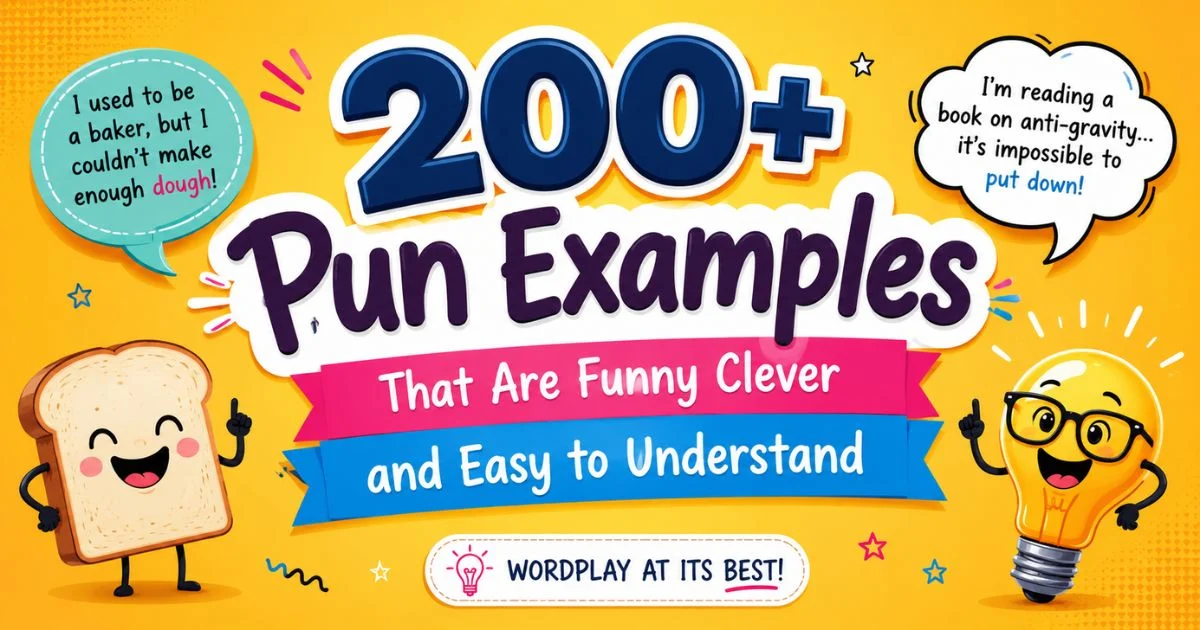
- I used to be a baker, but I couldn’t make enough dough.
- The library has thousands of stories.
- I wondered why the baseball was getting bigger. Then it hit me.
- I stayed up all night wondering where the sun went. Then it dawned on me.
These examples work because one word carries two different meanings at once.
Why Are Puns So Funny?
Puns entertain because our brains instantly recognize two meanings at the same time. That unexpected connection creates surprise, making puns memorable and enjoyable. They are widely used in comedy, advertising, books, movies, and everyday conversations. (Scribbr)
Different Types of Puns With Examples
Understanding the main types of puns helps you recognize and create your own clever jokes.
Homophonic Puns
Homophonic puns use words that sound alike but have different meanings or spellings.
Examples
- I see food, and I eat it.
- Need an ark? I Noah guy.
- The wedding cake was in tiers.
- England is wet because many kings have reigned there.
Homographic Puns
Homographic puns use the same spelling but different meanings.
Examples
- I used to be addicted to soap, but I’m clean now.
- Atoms make up everything.
- I don’t trust stairs. They’re always up to something.
- The calendar factory gave me a few days off permanently.
Compound Puns
Compound puns combine two or more fat jokes in one sentence.
Examples
- I couldn’t make enough dough, so I kneaded a change.
- The lumberjack couldn’t hack it, so they gave him the axe.
- The scarecrow was outstanding in his field because he truly earned it.
Visual Puns
Visual puns rely on images instead of spoken language.
Examples include:
- A dentist’s business card shaped like a tooth.
- A fish restaurant with a sign reading “Catch of the Day.”
- A coffee mug printed with “Espresso Yourself.”
Recursive Puns
Recursive puns require readers to understand one joke before discovering another hidden meaning.
Example:
Infinity is forever… and then some.
These are less common but highly appreciated by lovers of clever bold humorous language.
Tom Swifties
Tom Swifties combine dialogue with adverbs that create the joke.
Examples:
- “I lost my crutches,” Tom said lamely.
- “This is shocking,” Tom said electrically.
- “I love geometry,” Tom said pointedly.
150+ Funny Pun Examples by Category
Whether you’re writing a funny Instagram caption, entertaining friends, or adding humor to your writing, these pun examples are easy to understand and share. They also cover many real-world situations, helping you find the right joke for almost any occasion.

Animal Puns
Animals inspire some of the funniest **witty expressions and **comedy because many animal names naturally lend themselves to clever wordplay.
- You’re paws-itively amazing.
- Whale, hello there!
- Owl always love you.
- Don’t be koi with me.
- I’m feline great today.
- Alpaca my bags and leave.
- This party is un-frog-ettable.
- You’re otterly adorable.
- Bee yourself.
- Seal the deal.
Food Puns
Food jokes are perfect for restaurants, social media captions, greeting cards, and family gatherings.
- Lettuce celebrate!
- Olive you so much.
- Donut worry, be happy.
- You’re bacon me crazy.
- Orange you glad to see me?
- Peas be with you.
- Life is what you bake it.
- We make a great pear.
- Taco ’bout awesome.
- You’re one smart cookie.
School Puns
Students and teachers often use puns to make learning more enjoyable.
- You really aced it.
- You’re write on time.
- School is a class act.
- Pencil me in.
- That’s note-worthy.
- Math teachers have too many problems.
- Reading gives you novel ideas.
- History keeps repeating itself.
- Science is full of bright ideas.
- Geography rocks.
Love Puns
Perfect for Valentine’s Day, anniversary cards, or sweet messages.
- Olive you forever.
- I’m nuts about you.
- We were mint to be.
- You have a pizza my heart.
- You stole a pizza my heart.
- You’re tea-riffic.
- We make the perfect pear.
- You complete me.
- You’re my butter half.
- I love you berry much.
Work Puns
Light-hearted workplace humor can make meetings and office chats more enjoyable.
- Let’s taco ’bout business.
- Time flies when you’re filing.
- That’s how I roll… my office chair.
- Our teamwork is outstanding.
- I’m meeting my deadlines one coffee at a time.
- Spreadsheet happens.
- Office life has its ups and downs.
- Let’s get this project wrapped up.
- Success is always in the works.
- We nailed that presentation.
Holiday Puns
Holiday puns make festive greetings more memorable.
- Have an ice Christmas.
- Yule love this gift.
- Have an egg-cellent Easter.
- Witching you a Happy Halloween.
- Gobble till you wobble.
- New Year, new cheers.
- You’re snow wonderful.
- Tree-mendous holidays.
- Merry everything.
- Have a pawsome holiday.
Travel Puns
Travel lovers enjoy destination-inspired jokes.
- Rome wasn’t built in a day.
- Sea you later.
- Vacation mode is plane awesome.
- Take the scenic route.
- Life’s a beach.
- Passport to happiness.
- Let’s cruise into adventure.
- Mountains are calling.
- I’m shore you’ll enjoy it.
- Globe-trotting is wheelie fun.
Sports Puns
Sports fans appreciate fast, energetic wordplay.
- You’re a real goal-getter.
- That was a slam dunk.
- Life is all about balance.
- Tennis is served.
- Hole in one!
- That’s how I roll… bowling style.
- Kick-start your dreams.
- Keep your eye on the ball.
- We make a winning team.
- Don’t drop the ball.
Pun Examples in Everyday Sentences
Puns aren’t limited to jokes—they naturally appear in conversations, marketing, greetings, and social media.
Daily Conversations
- I’m reading a book on anti-gravity. It’s impossible to put down.
- My shoes have a sole purpose.
- The gardener really knows how to grow relationships.
- The baker rises to every occasion.
- Time flies like an arrow. Fruit flies like bananas.
Text Messages
- Have a grape day!
- Bee happy.
- Hope your day is tea-riffic.
- You’re simply egg-cellent.
- Stay pawsitive.
Instagram Captions
- Fries before guys.
- Seas the day.
- Taco Tuesday never disappoints.
- Feeling grape today.
- Donut stop believing.
Greeting Cards
- Wishing you an egg-cellent birthday.
- Hope your year is unbe-leaf-able.
- You’re one in a melon.
- Have a brew-tiful day.
- Sending owl my love.
Workplace Conversations
- Let’s hammer out the details.
- You’re crushing your goals.
- We really nailed that project.
- Time to branch out.
- Success is brewing.
Pun Examples in Literature, Movies, and Pop Culture
Puns aren’t just modern internet humor. Many famous authors, playwrights, filmmakers, and brands have used them for centuries to entertain audiences and make their work more memorable.
William Shakespeare
William Shakespeare frequently used **rhetorical devices and puns throughout his plays. Because many English words had multiple meanings during the Elizabethan era, his dialogue often contained clever wordplay.
Examples include:
- Romeo and Juliet uses puns to balance romance with humor.
- Hamlet includes double meanings that reveal characters’ emotions.
- Much Ado About Nothing relies heavily on witty conversations filled with puns.
These examples show that puns can add both humor and deeper meaning to storytelling.
Children’s Books
Many children’s authors use puns because they make language fun and help young readers understand multiple meanings of words.
Common examples include:
- Animal characters with pun-based names.
- Rhyming stories with playful word choices.
- Funny chapter titles that spark curiosity.
Puns also encourage vocabulary development and creative thinking.
Famous Brands
Businesses often use puns to make their slogans easier to remember.
Examples include:
- Hair salons using names like Curl Up and Dye.
- Coffee shops using phrases such as Espresso Yourself.
- Pet stores using Paws and Relax.
- Bakeries using Life Is What You Bake It.
These catchy names are memorable because they combine humor with branding.
Movies
Many animated films include puns for both children and adults.
Examples include:
- Character names based on occupations or personalities.
- Restaurant and shop signs hidden in the background.
- Dialogue that contains clever double meanings.
These jokes reward viewers who pay close attention.
TV Shows
Comedy series frequently rely on puns to create memorable one-liners.
You’ll often find puns in:
- Sitcom episode titles.
- Character catchphrases.
- Fake company names.
- News headlines within fictional stories.
This style of humor keeps dialogue entertaining without requiring long jokes
Why Writers and Comedians Use Puns

Puns are more than simple jokes. They are a powerful literary device that helps writers, speakers, marketers, and comedians capture attention and make their message memorable. A clever pun can turn an ordinary sentence into one that people remember long after they’ve read or heard it.
Here are the biggest reasons professionals use puns.
Add Humor
Humor is the primary purpose of a pun. A well-placed play on words creates surprise, making readers smile or laugh without needing a long joke.
Example
I wondered why the frisbee kept getting bigger. Then it hit me.
Make Content Memorable
People are more likely to remember witty language than plain statements. That’s why advertisers, teachers, and public speakers often include puns in their presentations.
Example
A bakery using the slogan:
“Life is What You Bake It.”
is much easier to remember than simply saying it sells fresh bread.
Improve Storytelling
Authors often use puns to reveal a character’s personality, lighten serious moments, or add hidden meanings to dialogue.
Classic writers such as William Shakespeare, Oscar Wilde, and Lewis Carroll frequently used puns to entertain readers while adding depth to their works.
Build a Brand
Many successful businesses use puns because they’re catchy and easy to remember.
Examples include:
- Planet of the Grapes
- Thai Me Up
- Curl Up and Dye
- Lord of the Fries
- Wok This Way
These names immediately grab attention and often become conversation starters.
Engage an Audience
Whether you’re giving a speech, writing a blog post, or posting on social media, puns encourage readers to stop and think about the double meaning. That extra moment of engagement makes your content more enjoyable.
How to Write Your Own Pun in 5 Easy Steps
Creating a good pun isn’t about luck. It follows a simple creative process that anyone can learn.
Step 1: Find Similar-Sounding Words
Look for homophones or words that sound alike.
Examples:
- Flour → Flower
- Sole → Soul
- Knight → Night
- Pear → Pair
These pairs often become the foundation of clever puns.
Step 2: Look for Double Meanings
Many English words have more than one meaning.
Examples include:
- Bark (tree / dog)
- Bat (animal / sports equipment)
- Jam (traffic / fruit spread)
- Match (competition / fire starter)
Using these words naturally creates humorous double meanings.
Step 3: Add Context
A pun works best when it fits the situation.
Instead of writing:
I like bread.
Try:
I’m on a roll today.
The second sentence surprises the reader because “roll” refers to both bread and success.
Step 4: Keep It Short
The funniest puns are usually brief.
Compare these:
❌ The baker who was very successful because he baked many delicious products eventually became famous.
✅ The baker rose to the occasion.
Shorter puns are easier to understand and share.
Step 5: Test It on Someone
If another person understands the joke immediately, your pun is probably effective.
If you have to explain it, try simplifying the wording or choosing a clearer double meaning.
Common Mistakes to Avoid When Writing Puns
Even experienced writers occasionally force a joke that doesn’t quite work. Avoid these common mistakes to make your puns more natural and enjoyable.
Forcing the Wordplay
A pun should feel effortless. If readers struggle to understand it, the joke loses its impact.
Using Confusing Double Meanings
Choose words with meanings that most readers already know.
Simple puns are usually stronger than overly complicated ones.
Overusing Puns
Too many puns in one paragraph can become distracting.
Mix puns with normal writing to keep your content balanced.
Ignoring Your Audience
A classroom joke may not work in a business presentation, while office humor might confuse young children.
Always consider who you’re writing for.
Choosing the Wrong Timing
Puns work best during lighthearted moments.
Avoid using them in serious discussions where humor may feel inappropriate.
Pun Examples vs Joke vs Wordplay vs Double Entendre
| Feature | Pun | Joke | Wordplay | Double Entendre |
| Main Purpose | Clever humor | Make people laugh | Creative language | Hidden double meaning |
| Uses Similar Sounds | Yes | Sometimes | Often | Sometimes |
| Uses Multiple Meanings | Yes | Occasionally | Yes | Yes |
| Requires Interpretation | Usually | Rarely | Sometimes | Yes |
| Common In | Comedy, writing, advertising | Stand-up comedy | Literature | Literature, movies, conversations |
Quick Summary
- Pun: Humor based on similar sounds or multiple meanings.
- Joke: Any humorous statement or story.
- Wordplay: Creative manipulation of language, including puns.
- Double Entendre: A phrase with two meanings, one often humorous or indirect.
Conclusion
Puns have remained popular for centuries because they combine intelligence, creativity, and humor in just a few words. Whether you’re writing a story, crafting a social media caption, creating a marketing campaign, or simply trying to make someone smile, a well-written pun can leave a lasting impression.
By understanding the different types of puns, studying real-world examples, and practicing simple techniques like using homophones and double meanings, anyone can create clever wordplay. The best puns are short, natural, and easy to understand, making them enjoyable for readers of all ages.
FAQs
What is a pun?
A pun is a figure of speech that creates humor by using words with similar sounds or multiple meanings.
What is the best example of a pun?
“I used to be a baker, but I couldn’t make enough dough.” It uses the word dough to mean both bread mixture and money.
What are the four main types of puns?
The most common types are homophonic, homographic, compound, and visual puns.
Why are puns funny?
Puns are funny because they surprise readers with an unexpected second meaning of a word or phrase.
What is a simple pun?
A simple pun is a short joke based on one word with two meanings, such as “The calendar’s days are numbered.”
Are puns a figure of speech?
Yes. Puns are widely recognized as a figure of speech and a literary device used to create humor and emphasize ideas.
What is the difference between a pun and wordplay?
A pun is one type of wordplay. Wordplay is a broader category that includes puns, rhymes, alliteration, spoonerisms, and other creative language techniques.
Can students use puns in writing?
Yes. When used appropriately, puns can make essays, speeches, presentations, and creative writing more engaging and memorable.